.png?width=1200&height=675&name=Blog%20Banners%20(2).png)
If you’ve ever found yourself white-knuckling it through peak season or a major sales surge that resulted in late shipments, stockouts, or radio silence from your 3PL, well…you already know what needs to change.
But here’s the thing most brands get wrong about switching fulfillment partners: they wait until something breaks catastrophically before making a move. By then, they're scrambling. Which might mean making a rushed decision in the middle of their busiest months and paying for it in missed orders and frustrated customers, or selecting a 3PL provider based solely on price.
Here’s the good news. Switching 3PLs doesn't have to feel like a do or die situation. With the right timing and a solid transition plan, you can make the move with minimal disruption, and set your brand up to scale no matter what the future may hold. Let's break down when (and how) to do it.
Table of Contents
- What is a 3PL Transition
- Why Timing Matters When Switching 3PLs
- The Golden Window: Best Time to Switch 3PLs
- The Secondary Window
- The Months to Avoid
- What a Smart Transition Timeline Looks Like when Switching 3PLs
- Five Signs It’s Time to Switch 3PLs (even if it feels scary)
- Making the Leap Without the Chaos
What is a 3PL Transition?
A 3PL transition is the process of moving your fulfillment operations from one third-party logistics provider (3PL) to another. This typically involves transferring inventory, integrating new systems, onboarding processes, and ensuring continuity in order fulfillment and customer experience. A successful 3PL logistics transition keeps disruption to a minimum, while improving key areas like shipping speed, cost efficiency, scalability, and operational visibility.
Why Timing Matters When Switching Fulfillment Providers
A 3PL provider transition isn't a light switch. Nor would you want it to be. No one wants to just stop fulfilling orders while they transition to a new provider.
It involves migrating inventory, integrating systems, testing workflows, and building a relationship with a new team. Depending on the complexity of your operation, a full transition can take anywhere from three to 12 weeks.
This should spell out something pretty obvious: Switching during your peak season is less than ideal.
The brands that nail this transition plan around their sales cycles, instead of struggling through them. They use their slower months to lay the groundwork so that when the next peak hits, their new fulfillment partner is already running alongside them at full speed.
When to Switch 3PLs
There are two windows that are recommended when switching fulfillment providers.
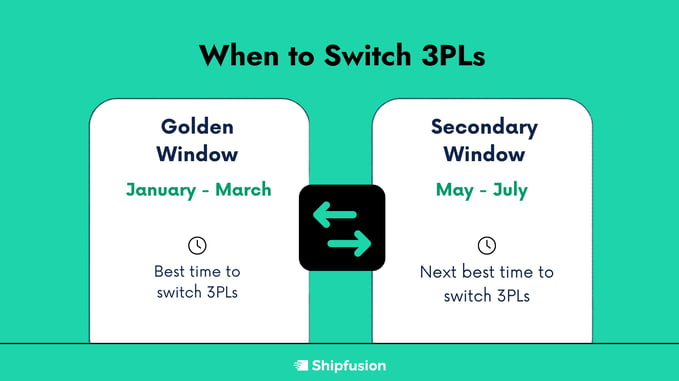
The Golden Window: The Best Time to Switch 3PLs
For most DTC ecommerce brands, the best time to switch 3PLs is January through March. Here's why this is the sweet spot.
Post-peak clarity
You've just lived through your highest-volume months. Every pain point your current 3PL has is fresh in your mind: the late shipments, the mis-picks, the support tickets that went unanswered for days. You've got real data and real frustration to fuel a smarter decision, not just a gut feeling.
Lower order volume
After the holiday rush, most brands see a natural dip in orders. This is exactly when you want to be migrating inventory and testing new workflows. Lower volume means lower stakes if there are any hiccups during the transition, and it gives your new 3PL room to ramp up without the pressure of a peak rush.
Budget planning alignment
Q1 is when most brands finalize their operating budgets for the year. Switching 3PLs in this window means you can negotiate new rates, factor in transition costs, and set realistic fulfillment spend projections for the next 12 months. No surprises in Q3 when you're trying to scale into peak.
Plenty of runway
A January or February kickoff gives you a solid six to eight months before the next holiday season. That's more than enough time to fully onboard, optimize your workflows, and build a real working relationship with your new partner, so you're not just "set up" by peak, you're thriving.
The Secondary Window: May through July
If Q1 slipped by (no judgment… post-peak recovery is real), your next best window to switch 3Pls is late spring to mid-summer. You can always use the beginning of the year to make the call that it’s time to switch, conduct your research, and have a partner lined up by the time you’re cruising into the summer season.
Of course, keep in mind your own individual peaks. Some seasonal brands, like sunscreen, camping gear, or swimwear, might find this window completely the wrong choice, in which case the golden window outlined earlier truly is your safest bet.
Let’s take a look at why this secondary window still works for most DTC brands.
Pre-peak preparation
Deciding to switch 3PLs and start a transition in May or June still gives you three to four months before the back-to-school and early-fall promotional cycles kick off, and a solid five to six months before Black Friday and Cyber Monday. It's tighter than Q1 but absolutely doable, especially if your SKU count is manageable and your new 3PL has a proven onboarding process.
Seasonal product launches
Many DTC brands use summer to introduce new products ahead of fall and holiday campaigns. If you're already planning to send new inventory to a warehouse, it’s a natural opportunity to send it to the right warehouse.
Team bandwidth
By mid-year, your operations team has likely recovered from the post-holiday crunch and has the capacity to manage a transition project without burning out. Transitions need someone driving them internally, and your team needs the headspace to do it well.
The Months to Avoid when Switching 3PLs (Or At Least Approach with Caution)
The golden rule: The closer to peak, the more pressure you’re putting onto the transition to a new 3PL provider. That being said, if you simply can’t face another peak season with a less-than-ideal partner, it might be the type of risk worth taking.
1. August through November
There are different levels of danger in this zone. Having a trusted 3PL lined up and your inventory shipped over by the beginning of October may give your new partner sufficient time to learn your business. Again, the earlier, the better.
But if you’re dealing with elements like complex inventory management, custom packaging, special projects, and unique order fulfillment or shipping rules, you might simply be cutting it too close. Trying to compress that learning curve into peak season is how fulfillment nightmares happen (again!).
So what’s the alternative? If you can survive with your current provider through one more peak season, use this last window of the year for planning.
In fact, August and September are great for vetting potential providers, requesting proposals, visiting warehouses, and narrowing your shortlist for an early-year transition. Just don't expect to be fully transitioned and shipping from a new facility during your highest-volume period.
2. December is a hard no for when to switch 3PLs
Unless your brand has a completely flat sales cycle (rare in DTC), December is a hard no for transitions. Your current fulfillment provider is focused on getting holiday orders out the door, your new partner's warehouse is packed with other clients' peak inventory, and your team is managing holiday campaigns. Save the move for January.
What a Smooth Transition Timeline Looks Like when Switching 3PLs
Here's a realistic timeline for a brand switching 3PLs in Q1, targeting full operational readiness by mid-year:
Weeks 1-2: Discovery and onboarding kickoff
Your new 3PL should assign a dedicated account manager (not just a generic onboarding team) who learns your business inside and out: your SKUs, packaging, shipping preferences, and peak patterns. This is where the relationship starts, and it matters. Every Shipfusion client has their own account manager who is actually introduced pre-onboarding to best understand your pain points and how we can address them.
Weeks 3-4: Systems integration
Connect your ecommerce platform, marketplace channels, and any other order sources to your new 3PL's warehouse management system. At Shipfusion, this happens through Shipfusion 360, which gives you real-time visibility into every order and every dollar spent, from day one.
- Easy integration with ecommerce platforms
- Real-time inventory visibility
- Forecast demand before it becomes a stockout
- Drill down to every fulfillment fee, storage cost, and shipping charge by order
- Build your own workflows and submit custom projects
Weeks 5-6: Inventory migration
Ship existing inventory to your new warehouse. Smart brands do this in waves. If possible, start with your top-selling SKUs so you can begin order fulfillment from the new location while slower-moving stock catches up.
Weeks 7-8: Testing and parallel fulfillment
Run a subset of orders through the new 3PL to test accuracy, speed, and packaging quality. Some brands run both partners in parallel for a brief period to ensure nothing falls through the cracks during the cutover.
Weeks 9-12: Full transition and optimization
Once you're confident in the new setup, flip the switch completely. Your dedicated account manager should be actively reviewing performance metrics with you, fine-tuning shipping rules, and flagging opportunities to improve your logistics strategy.
Thinking about switching 3PLs but not sure where to start?

You're not alone. Most brands stay too long with the wrong partner, not because switching is hard but because it feels that way.
Our guide gives you the full playbook: a cost calculator, a vetting framework, an exit checklist, and a week-by-week roadmap to make the switch in 30–45 days without missing a single order.

Five Signs It’s Time to Switch 3PLs (Even If It Feels Scary)
Switching 3PLs sounds like a headache. And honestly? It can be if you do it reactively. But if any of these feel familiar, the cost of not switching is almost certainly higher than the short-term disruption of making the move.
#1 - Your error rate is climbing
Mis-picks, wrong addresses, high shipping costs, damaged products — these aren't just operational issues. They're customer experience killers. If your 3PL's accuracy is slipping as you grow, that's a scaling logistics problem, not a one-off.
#2 - You can't get anyone on the phone
If your 3PL takes days to respond to support tickets (or worse, routes you through a call center that doesn't know your account), you don't have a partner, you have a vendor. There's a difference.
#3 - Peak season was painful
If your last peak felt like survival mode instead of a growth opportunity, that's a red flag. The right 3PL fulfillment solution should make peak season feel manageable, not terrifying.
#4 - You've outgrown their capabilities
Maybe you're launching new channels, expanding into retail, or scaling to a volume that your current 3PL simply can't handle without delays. Growth is a good problem, but only if your fulfillment can keep up.
#5 - You're spending more time managing fulfillment than growing your brand
This is the big one. If your Ops Manager is spending 15 hours a week babysitting the warehouse instead of focusing on strategy and growth, something's broken. Purity Coffee’s incoming tickets jumped by 70% with their previous 3PL, overwhelming their customer experience team. After switching 3PLs, their order accuracy rate skyrocketed to 99.9% and packing errors practically disappeared.
Making the Leap Without the Chaos
We've worked with many brands that have made the switch. Nearly all of them said the same thing: "I wish we'd done this sooner."
The key isn't just when you switch, it's how. The best transitions happen when your new third party logistics partner treats the onboarding like a real partnership, not a checklist.
That means:
- A dedicated account manager who's on-site (not outsourced)
- A portal that gives you full visibility from day one
- A team that's proactive about solving problems before they become yours
Switching fulfillment partners is one of those decisions that feels heavy in the moment but pays dividends for years. And the brands that time it right by using their post-peak window to make the move don't just avoid disruption, they set themselves up to scale with confidence into their biggest year yet.
Ready to see what a fulfillment partner built for growth actually looks like?


.png?width=800&height=500&name=Blog%20Banners%20(5).png)
-1.png?width=800&height=500&name=Blog%20Banners%20(1)-1.png)