
To understand how inventory and product management work together, you should know three fundamental concepts: SKUs, UPCs, and barcodes. These three terms are usually interchangeable, but each plays a different role in operations and inventory management. Ultimately, they affect customer experience.
This article explains the key differences between SKUs, UPCs, and barcodes, their uses, and how you can unlock their full potential for your business operations.
Table of Contents:
-
The Importance of Understanding SKU vs. UPC vs. Barcode In Inventory Management
-
With SKU vs. UPC vs. Barcode Differentiated, Let's Put Both to Work
Defining SKU, UPC, and Barcodes
What Is SKU?
SKU, or Stock Keeping Unit, is a unique alphanumeric identifier. Retailers use it internally by attaching a code to each product variation they sell. Typically consisting of 8 to 12 characters, SKUs are customizable and reflect specific product attributes like size, color, brand, department, and warehouse location. Where they differ from universal codes is that they are retailer-specific and can be structured according to each business’s needs.
For example, a clothing brand might create SKUs such as SWEATSHIRT-RED-M-2026 and SWEATSHIRT-BLU-L-2026 to show the size and color differences within the same product range. This individual approach lets businesses tailor their units to their own inventory needs.
What Is UPC?
UPC stands for Universal Product Code, a 12-digit barcode system recognized worldwide in the retail industry. Administered by GS1, an international organization that sets standards for product identification, UPCs give retail companies a consistent point-of-sale product identification system, used with bar code scanners.
A UPC’s main purpose is to define the product itself, rather than to provide specific details about it. A product's UPC remains the same across retailers and geographic locations, providing a strategic advantage for manufacturers and distributors that need their products to be easily and instantly recognized, regardless of where they are.
For example, imagine a manufacturer who has assigned the same UPC code to a particular soda product. This can be scanned consistently in any supermarket across the nation, making it easy to track sales and process returns.
What Is a Barcode?
A barcode is a machine-readable data bar, a series of parallel lines, dots, or other geometric patterns. It is a physical medium with which both SKUs and UPCs are encoded and scanned. While a UPC is a specific standardized barcode format, barcodes themselves use different encoding systems, such as Code 39, Code 128, QR codes, and Data Matrix codes.
Barcodes convert alphanumeric data into a scannable, visual pattern that can be quickly used in warehouses, retail environments, and supply chain operations. They can encode both universal identifiers, such as UPCs, and internal identifiers like SKUs. This makes them a practical tool for managing inventory, tracking sales, assets, and point-of-sale transactions.
SKU vs. UPC vs. Barcode: The Key Differences
Together, SKUs, UPCs, and barcodes deliver well-organized, efficient inventory management. You can see below the differences between these three identification systems at a glance:
|
Attribute |
SKU |
UPC |
Barcode |
|
Scope |
Internal/Retailer-specific |
Universal/Global |
Visual encoding method |
|
Customization |
Very customizable |
Fixed and standardized |
Flexible symbology options |
|
Purpose |
Inventory tracking & analysis |
Product identification & POS |
Machine-readable scanning |
|
Changeability |
Can be modified/retired |
Remains static |
Updated as needed |
|
Primary Benefit |
Detailed operational control |
Multi-channel consistency |
Automated data capture |
Thanks to their inherent customization, SKUs are more flexible, making it easier for each retailer to develop unique classification systems tailored to their needs. The codes can change alongside products, and businesses redefine or discontinue SKUs when required.
In contrast, UPCs deliver standardized consistency across platforms and retailers and remain unchanged throughout a product's lifecycle.
Barcodes are the technical bridge that spans the two, giving the visual scanning feature that makes both SKUs and UPCs functional in automated inventory systems.
When to Use SKU vs UPC vs Barcodes
The right identification system depends on your own business needs, operational requirements, and strategic objectives. Here is a practical list for decision-making scenarios:
Use SKUs when:
✓ Managing internal inventory over many different warehouse locations or retail stores
✓ Tracking different products and variations (size, color, style) all with the same UPC
✓ Checking sales performance, inventory turnover, and restocking requirements by specific product attributes
✓ Operating with your own retail ecosystem and no third-party marketplace sales
✓ Matching your warehouse layout or business logic through inventory customization.
Use UPCs when:
✓ Selling products across multiple retail channels or third-party marketplaces (Amazon, Walmart, Target)
✓ Initiating standardized checkout processes across different point-of-sale systems
✓ Setting up product listing requirements for major e-commerce platforms and marketplaces
✓ Guaranteeing constant and accurate product identification throughout the entire supply chain from manufacturer to end consumer
✓ Conforming to regulatory or industry compliance requirements for product tracking and recall management
Use Barcodes when:
✓ Automating inventory scanning and data capture practices to eliminate manual entry errors
✓ Applying the warehouse management systems necessary for rapid item identification and tracking
✓ Encoding SKUs or UPCs into machine-readable formats for scanning equipment
✓ Quickening the checkout processes and making transaction accuracy at point-of-sale terminals more accurate
✓ Supporting mobile inventory management along with real-time stock verification in both retail and warehouse environments
The Importance of SKU vs. UPC vs. Barcode In Inventory Management
What makes inventory management a success? The secret lies in using the right identification system at the right time to improve operations and overall efficiency.
Role of SKU In Inventory Control
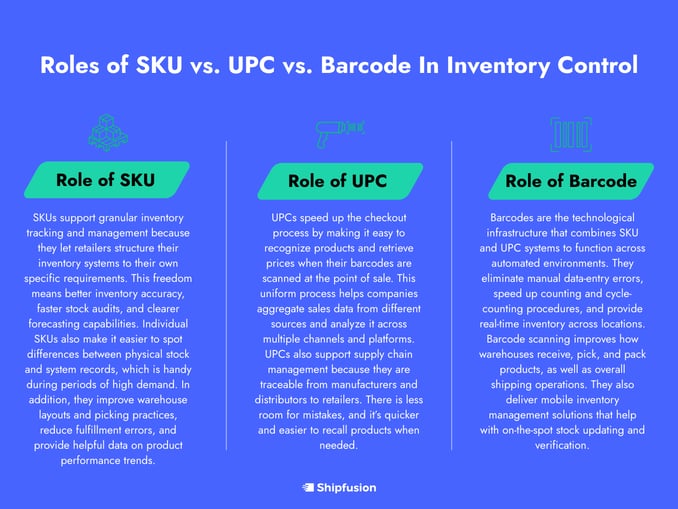
SKUs support granular inventory tracking and management because they let retailers structure their inventory systems to their own specific requirements. This freedom means better inventory accuracy, faster stock audits, and clearer forecasting capabilities. Individual SKUs also make it easier to spot differences between physical stock and system records, which is handy during periods of high demand. In addition, they improve warehouse layouts and picking practices, reduce fulfillment errors, and provide helpful data on product performance trends.
Role of UPC In Inventory Control
UPCs speed up the checkout process by making it easy to recognize products and retrieve prices when their barcodes are scanned at the point of sale. This uniform process helps companies aggregate sales data from different sources and analyze it across multiple channels and platforms. UPCs also support supply chain management because they are traceable from manufacturers and distributors to retailers. There is less room for mistakes, and it’s quicker and easier to recall products when needed.
Role of Barcode In Inventory Control
Barcodes are the technological infrastructure that combines SKU and UPC systems to function across automated environments. They eliminate manual data-entry errors, speed up counting and cycle-counting procedures, and provide real-time inventory across locations. Barcode scanning improves how warehouses receive, pick, and pack products, as well as overall shipping operations. They also deliver mobile inventory management solutions that help with on-the-spot stock updating and verification.
How to Use SKU, UPC, and Barcodes Effectively
These three systems should be used to boost operations and maximize inventory accuracy. Below is a comparison chart, followed by actionable best practices for each system.
|
Feature |
SKU |
UPC |
Barcode |
|
Format |
Alphanumeric (8-12 chars) |
12 digits numeric |
Visual pattern encoding |
|
Assignment |
Created by a retailer |
Issued by GS1 |
Generated from data |
|
Cost |
Free (internal) |
GS1 licensing fee |
Printing/equipment costs |
|
Best For |
Internal operations |
Multi-channel selling |
Automated scanning |
|
Lifespan |
Flexible/can change |
Permanent |
Depends on label quality |
|
Visibility |
Internal systems only |
Public/universal |
Physical product labels |
|
Integration |
Inventory software |
POS & marketplaces |
Scanning hardware |
Best Practices for SKU, UPC and Barcode
Some simple best practices can boost your performance and make your business inventory management systems more reliable and flexible:
SKU Best Practices:
✓ Always use clear, consistent naming conventions that include correct abbreviations for categories, subcategories, and attributes
✓ Maintain SKU length between 8 and 12 characters for readability and system compatibility
✓ Don’t use spaces or special characters that can cause database issues; use hyphens or underscores as separators
✓ Record your SKU structure in a reference guide for all team members to access
✓ Run audits every quarter to archive inactive SKUs and streamline your catalog
✓ Use inventory software to integrate SKU management for automated tracking and real-time reporting
✓ Train staff members on how to use and scan SKUs to make their jobs easier and your operations more efficient.
UPC Best Practices:
✓ Order UPCs from GS1, the official licensing authority, for universal compatibility and to avoid conflicts
✓ Verify UPC assignments with your inventory system to stop potential sales discrepancies
✓ Check for manufacturer updates for UPC changes due to packaging revisions or rebranding initiatives
✓ Keep a central database linking UPCs to product information for quick reference and updates
✓ Test barcode scanners on a regular basis to keep accurate UPC reading at all point-of-sale terminals
✓ Work with suppliers to guarantee UPC accuracy before you receive products or for catalog updates
✓ Backup and record UPC assignments to recover in case of disaster and if you migrate systems in the future.
Barcode Best Practices:
✓ Choose the right barcode symbols (Code 39, Code 128, QR product codes) based on data requirements and scanning environment
✓ Make certain that barcode print quality meets minimum resolution standards (typically 300 DPI) for scanning quality
✓ Place the barcodes on packaging where they are most visible and not prone to damage or wear
✓ Standardize barcode verification processes during product receiving to catch printing errors early
✓ Maintain barcode scanners with regular calibration and cleaning to prevent reading failures
✓ Contrast the colors (black bars on white background) for the best scan results
✓ Make and use standard operating procedures to handle damaged or unreadable barcodes in warehouse operations
Meet Shipfusion 360 by Shipfusion
Shipfusion 360 is your eyes and ears in our warehouses, from anywhere in the world. Take control of your orders, inventory, and operations with Shipfusion’s enterprise-grade features and controls.
Common Misconceptions About SKU vs. UPC vs. Barcode
A common misconception about inventory management is that both SKUs and UPCs are interchangeable. Even though they are both used to identify products, they actually serve different purposes.
SKUs are created internally and used to organize, keep track of, and analyze inventory according to a company’s own needs. UPCs are standardized and recognized globally by retailers and marketplaces for product consistency across systems. You shouldn’t interchange one for the other, as you risk reporting gaps and could face retail compliance issues.
Another misconception is that a barcode is a type of SKU or UPC. It isn’t. A barcode is just the visual, scannable representation of data, frequently a SKU or UPC. The actual barcode itself has no meaning without the identifier behind it. Many businesses also assume that only large retailers need UPCs, but it is common for small or direct-to-consumer brands to adopt them as they expand into wholesale channels and larger marketplaces.
Finally, there is a belief that one identifier is enough for everything, but proper inventory systems rely on SKUs, UPCs, and barcodes working together.
With SKU vs. UPC vs. Barcode Differentiated, Let's Put All Three to Work
When you understand the difference between SKUs, UPCs, and barcodes, your business can use them as strategic assets to improve operations through better tracking and monitoring.
SKUs provide internal flexibility for granular inventory management and detailed performance metrics. UPCs give the order and standardization needed for flawless multi-channel selling and supply chain coordination. Barcodes provide the technological aspect that fuses the two systems through automated data capture.
Businesses can achieve greater operational efficiency and inventory accuracy with these three complementary tools. When used together, they improve customer satisfaction, reduce operational costs, and provide invaluable data and metrics about inventory traffic. That’s how your business can sustain growth while managing inventory efficiently and effectively.
Brands scale faster with Shipfusion.
Ready to turn better inventory control into faster growth? Shipfusion is the 3PL purpose-built for rapidly scaling DTC brands — helping you streamline operations, improve accuracy, and deliver a better customer experience. Get a custom quote today and see how Shipfusion can power your next stage of growth.