
.png?width=1200&height=675&name=Blog%20Banners%20(1).png)
Many companies are venturing into modern logistics. In doing so, they encounter many confusing industry terms. For instance, the terms “3PL providers” and “freight brokers” are often used interchangeably, even though they have different meanings, and both serve two different roles. Companies that move physical goods should understand the differences between these two service types, as the wrong choice can cause adverse consequences, including slower shipments, higher costs, and hampered growth.
Both 3PL and freight brokers move goods through the supply chain, but a freight broker concentrates only on transportation, whereas a 3PL provides complete end-to-end logistics, including warehousing, fulfillment, and inventory management.
This post takes a detailed look at the many key differences between freight brokers and third-party logistics providers and how they both operate in the modern freight shipping industry.
Table of Contents:
- What is the difference between a 3PL and a freight broker?
- 3PL vs. Freight Broker Direct Comparison
- What is a freight broker?
- What is a 3PL?
- When should you use a freight broker vs. a 3PL?
- 3PL vs. Freight Brokers: Which is right for you?
What Is the Difference Between a 3PL and a Freight Broker?
Although both freight brokers and third-party logistics providers provide services that move goods through the supply chain, their roles are quite different.
A freight broker’s role is primarily about transporting goods from point A to point B - nothing more. However, third-party logistics (3PL) providers handle more comprehensive business needs, such as warehouse storage, fulfillment, and ongoing inventory management.
So, basically:
- A freight broker books transport for your goods.
- The third-party logistics provider provides the infrastructure to manage and store inventory, as well as pick, pack and ship your products to customers.
Presently, the global 3PL providers market is rapidly expanding due to the increasing demand from ecommerce companies outsourcing their supply chain management services.
The main points of difference are listed below.
3PL vs. Freight Broker Direct Comparison
|
Category |
Freight Broker |
3PL Provider |
|
Primary role |
Connecting shippers and carriers |
Coordinates the entire logistics system |
|
Assets |
No warehouses or vehicles |
Runs warehousing and distribution centers |
|
Core services |
Manage freight movement and negotiate rates |
Storage management, handling, packing, and shipping |
|
Technology |
Systems for locating a carrier and booking a shipment |
Platforms that support inventory and order fulfillment |
|
Best for |
Single or specific transport jobs |
Ongoing/lasting logistics partnerships |
What Is a Freight Broker?
A freight broker is defined as a non-asset-based intermediary. They simply link companies that need their goods shipped to freight carriers with the capacity to transport them.
Whereas asset-based logistics providers own assets such as trucks and warehouses, freight brokers do not own any assets; they simply use a brokerage model to link shippers with freight carriers. The role of freight brokers is totally focused on transportation. They book the trucks, negotiate transport rates, and manage the flow and movement of freight during the shipping process.
The freight brokerage process begins with a shipper’s request for a quote. The broker then goes over its network to assign and secure a truck from one of its freight carriers. Once a carrier is assigned to the shipment, it is scheduled and monitored until delivery.
Since freight brokers do not store goods but only transport them, their services are suitable only for companies with their own outsourced logistics or their own logistics infrastructure.
Freight Broker: Pros and Cons
Pros of Freight Broker
- Access to substantial carrier networks helps them move shipments quickly
- Competitive cost negotiation with current market rates
- Can offer occasional one-off shipment needs
Cons of Freight Broker
- Do not support any warehouse or warehousing operations
- Have no inventory management or fulfillment capabilities
- Transaction-based relationships compared to long-term logistics partnerships
What Is a 3PL (Third-Party Logistics)?
A third-party logistics provider offers a much larger set of services than a transport intermediary.
While a transport intermediary organizes a single shipment, a 3PL provider provides ongoing logistics services to streamline the movement, storage, and delivery of products.
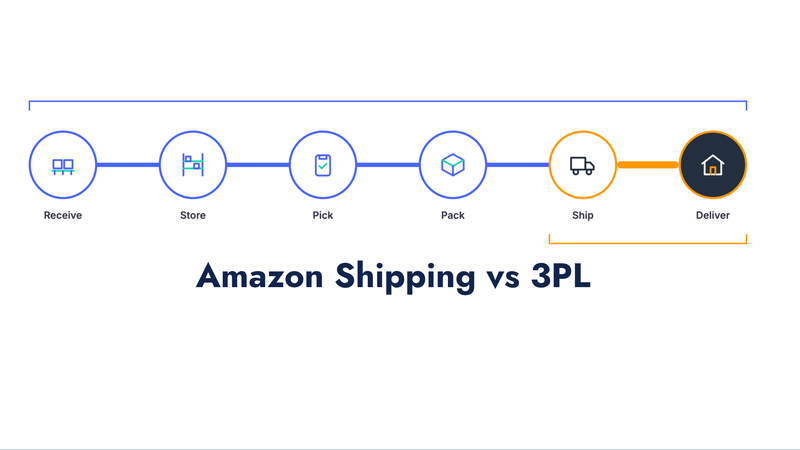
Most 3PL providers have networks and physical infrastructure with platforms designed to handle and support the day-to-day logistics operations of ecommerce companies and growing brands. That includes receiving and storing inventory, picking goods from shelves, packaging them, shipping them, and handling all returns.
Because 3PLs are more than just transport intermediaries, owning actual physical infrastructure, like warehouses and distribution systems, they become operational partner organizations.
Pros of a 3PL
- Offer scalable logistics solutions for growing businesses and ecommerce brands
- Have full management platforms that can integrate with sales channels
- Quicker shipping speeds that improve customer satisfaction
Cons of a 3PL
- Requires onboarding and integration with the logistics process
- Means longer-term operational relationships
Key Differences Between 3PLs and Freight Brokers
To fully explain the real differences and how they affect the roles of 3PL and freight carriage, this comparison highlights their distinct uses, technologies, and long-term strategic impacts.
Scope of Services
The largest difference between these two services is the scope of work they do.
The freight broker only coordinates one part of the transportation. They are connected to shippers and carriers, guaranteeing shipments are safely moved from point A to point B.
In contrast, the third-party logistics provider controls the whole process of goods distribution. That includes warehousing, order fulfillment, packing, transporting the products, and returns. With this larger canvas and scope, 3PLs are more deeply involved in supply chain management, while brokers simply organize freight movement.
Technology & Integration
Technology is another area that sets 3PL providers apart from freight brokers.
Freight brokers rely on transportation platforms to locate trucks, track market rates, and move freight from shippers to carriers.
A 3PL provider, on the other hand, uses sophisticated warehouse management technology to track inventory and manage picking workflows that integrate directly with ecommerce platforms.
These integrations allow businesses to gain real-time visibility into their inventory and orders, helping them to scale their domestic and international shipping operations without developing these solutions in-house.
Meet Shipfusion 360 by Shipfusion
Shipfusion 360 is your eyes and ears in our warehouses, from anywhere in the world. Take control of your orders, inventory, and operations with Shipfusion’s enterprise-grade features and controls.
Relationship & Liability
Another big difference between the two concerns accountability and the nature of the business relationship.
Freight brokers mostly use a transaction-based model, where a company gets a quote, the broker organizes a truck, and the transaction concludes after the goods are delivered.
A 3PL provider differs by being an operational partner responsible not only for storing inventory but also for accurately accounting for it and supporting ongoing fulfillment operations. Because they physically move and handle products, they assume greater responsibility for operational accuracy and performance.
Operational Complexity
Businesses with intricate distribution requirements often need broader logistics solutions than a freight broker can offer.
For example, a freight broker can handle palletized freight with ease, but they cannot handle order processing, product picking, or ecommerce solutions. 3PLs can easily handle these processes. Capabilities include handling inbound freight, organizing inventory, and complex order fulfillment processes.
When Should You Use a Freight Broker?
A freight broker is often the best choice if a company already manages most of its logistics infrastructure. That is often the case for companies like manufacturers, wholesalers, and distributors who have their own warehouses but may occasionally need help with moving large amounts of freight.
In such cases, freight brokers can offer access to a broad array of freight carriers and can secure competitive pricing for particular routes. As they specialize solely in transportation, they are the perfect solution for companies that only need help with arranging trucking services.
When Should You Use a 3PL?
The choice between 3PL and freight often arises when a business starts to expand.
Firms that conduct business online or ship products directly to consumers may require services beyond freight booking. Many new third-party logistics companies today focus on serving ecommerce brands that require integrated shipping, inventory, and flexible logistics solutions.
A company that requires scalable fulfillment can benefit from a 3PL provider’s better inventory management and faster delivery without having to build its own warehouse infrastructure.
Companies that contract these services to a third-party logistics provider can focus on product development, marketing, and business growth while professionals handle backend operations. Need help finding a 3PL provider? Here is a list of the top 15 best 3PL services in the United States.
If your post-purchase experience isn’t as polished as your branding, you’re leaving revenue and reputation on the table.
Download our DTC Delivery Files: Cosmetics Edition and gain insights to compare your fulfillment to other growing DTC brands and identify areas for improvement.

Can You Use Both?
In practice, most businesses use both of these services simultaneously.
For example, a company might use a third-party logistics provider to manage its warehousing, order fulfillment, and day-to-day shipping operations. At the same time, the same company might use a freight broker to haul palletized products from the manufacturer to the 3PL warehouse.
Each service has a distinct role within the broader supply chain.
What About Freight Forwarders?
Freight forwarders are another term you may encounter in logistics, and are often confused with freight brokers. The key distinction is scope: freight brokers arrange domestic trucking, while freight forwarders specialize in international shipments, handling customs documentation, import/export compliance, and cross-border coordination. If your business ships goods overseas, a freight forwarder may be relevant alongside or instead of a freight broker. However, for end-to-end logistics management, a 3PL remains the more comprehensive solution.
3PL vs. Freight Brokers - Which Is Right for You?
Ultimately, the decision between a freight broker and a third-party logistics provider will depend on the level of support that your business needs and its specific shipping requirements.
For example, if all that your business needs is for a truck to transport freight, then the freight broker vs 3PL decision will likely be in favor of a freight broker. However, if your business needs infrastructure to store its inventory and manage orders and multiple shipments, then working with a third-party logistics provider will give you access to significantly more logistics support.
Ultimately, a freight broker arranges transportation for your cargo. A third-party logistics provider provides your products with a home, along with the option to scale with your business as it grows, giving you long-term support and bandwidth for your expansion and a steady partnership.
Shipfusion is the 3PL purpose-built for rapidly scaling DTC brands. Shipfusion helps you streamline operations, improve accuracy, and deliver a better customer experience.
Get a custom quote today and see how Shipfusion can power your next stage of growth.


-2.png?width=800&height=500&name=Blog%20Banners%20(1)-2.png)
.png?width=800&height=500&name=Blog%20Banners%20(7).png)