BFCM is the busiest stretch of the year for ecommerce brands, and whether your fulfillment can absorb the spike decides what the weekend is actually worth. You’re bidding against every other brand in your category for the same attention, during a season when online spend hit a record $257.8 billion. Then the order lands in a warehouse that may or may not be able to ship it on time. If it goes wrong, you’ve paid premium prices to acquire a customer and handed them the one experience most likely to stop them from ever buying again. For a brand where six weeks carries a meaningful share of annual revenue, that’s not an ops problem. That’s the year.
Last year during peak, we audited 18 DTC skincare brands. Everyone ran a sale, but not everyone was ready for what came with it. Most brands treat BFCM as a marketing event, but the ones that win it treat it as an operations event.
On this page:
- How We Audited BFCM Fulfillment Across 18 DTC Brands
- Gap 1: Your promotions are outpacing your BFCM fulfillment
- Gap 2: Holiday bundles break fulfillment without real kitting capability
- Gap 3: One shipping option isn't a choice
- Gap 4: Holiday shipping cutoff dates aren’t doing their job
- The Returns Gap
- Strong BFCM fulfillment: RemedyScience
- Six BFCM Fulfillment Questions to Ask Your 3PL Before Peak
- FAQ
How We Audited BFCM Fulfillment Across 18 DTC Brands
We tracked every promotion, shipping option, bundle, and cutoff message across 18 DTC skincare brands from November through December 2025. We weren’t grading creative or conversion rates. We were looking at what happens after someone hits buy, and whether the operation behind the sale could keep the promise the marketing made.
One thing worth being upfront about: this was an outside-in audit. We observed what any shopper could see - promo structures, checkout options, site messaging. Most of these brands aren’t Shipfusion customers, which did not allow for internal visibility.
This piece covers four specific gaps we found in our audit. If you want the wider operational picture - inventory forecasting, staffing, carrier capacity - start with our guide to peak season logistics and come back to this one.
18 brands. 30+ days. Every promotion, bundle, shipping option, and cutoff message we tracked, plus the complete breakdown of our winning brand’s approach. Download the full report!.
Gap 1: Your promotions are outpacing your BFCM fulfillment
BFCM promos get more complex every year with staggered offers, tiered discounts and rotating daily deals, one brand we audited ran a new sale for every single day of November.
Here’s how the 18 brands played it:
- 82% ran a sitewide % off. The industry default, and a race to the bottom. Your 15% looks pretty thin next to a competitor’s 40%.
- 53% offered a gift with minimum purchase. The second-most common lever, and one that requires specific pick-and-pack logic at the warehouse.
- 29% discounted specific items or bundles. More targeted, but it needs real special projects capability.
- 12% ran spend-more-save-more tiers. Great for AOV, hard on fulfillment when volume spikes.
- 6% ran a sign-up-and-save offer. Rare, and a genuine way to stand out — if your operation can handle the long-term lift.
Most brands weren’t running just one promotion, either. 35% ran two promotions across November and December, 18% ran three, and 6% ran four or more. Another 41% extended past BFCM into December, which means extended BFCM fulfillment pressure right along with it.
Every one of those layers lands on your 3PL because it involves a change in pick logic and new pack requirements. The noise of BFCM can pressure you into thinking you need to match every competitor offer, but a single strong promotion executed cleanly beats four promotions that generate errors. Happy customers are still the goal.
How to close it: Before you finalize your promo calendar, we recommend running every planned promotion past your 3PL for a capability check. If you’re staggering offers or tiering gifts with purchase, confirm they have the pick-and-pack logic, kitting capability, and peak season capacity to execute each one cleanly. Ask what daily order volume they’re planning to absorb for your account specifically, and what happens above that line. Get the answer in writing before peak, not during it.
Gap 2: Holiday bundles break fulfillment without real kitting capability
Holiday bundles drive revenue as well as warehouse complexity.
71% of brands offered holiday-exclusive bundles, 65% offered a multi-threshold gift with purchase, and 18% offered a gift with no threshold at all. Every one of those adds kitting, picking, packing, and inventory complexity on top of peak volume.
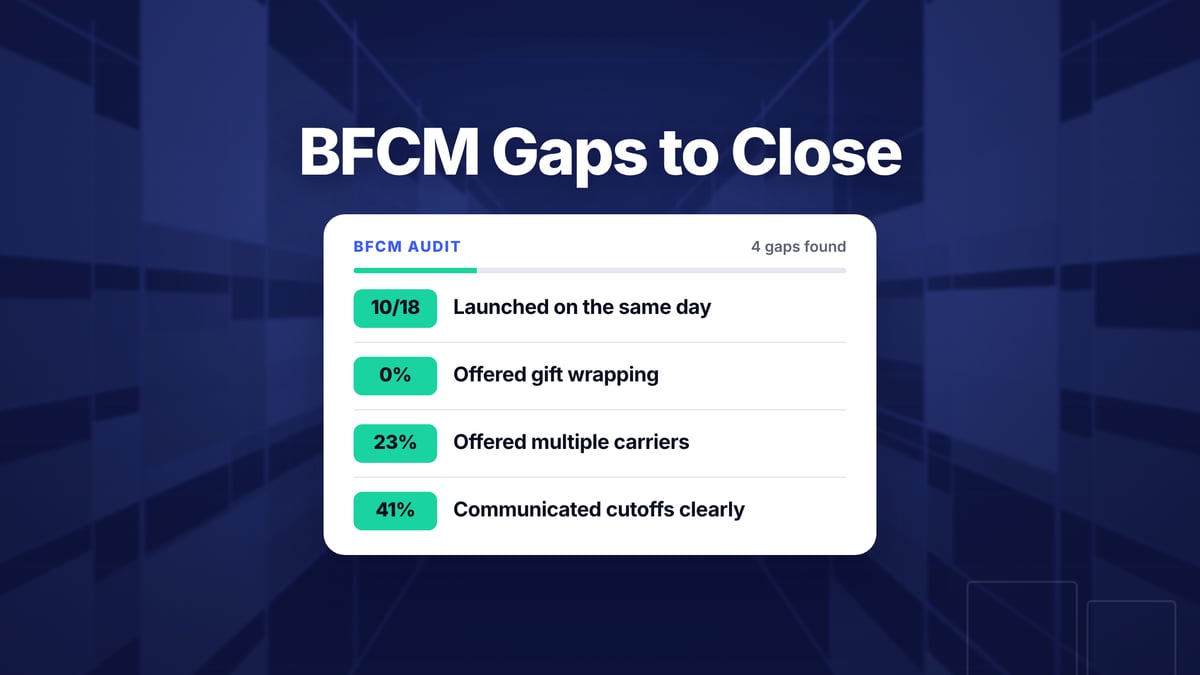
Then there’s the stat nobody expected: 0% offered gift wrapping. Not one brand out of 18, during the biggest gifting season of the year. That’s not a coincidence. It’s a signal that many 3PLs can’t support special project add-ons at scale.
Gift-ready packaging is the shortcut; limited-edition giftable SKUs built on the fly, means no wrapping station is required, and the right partner will build those with you instead of telling you it’s not possible. For beauty and skincare brands especially, where bundled routines and curated sets are the whole holiday strategy, that capability is the difference between a gift offer you can run and one you can only plan.
How to close it: Ask your 3PL specifically how they plan for special projects during peak, not whether they’re willing to try. Willingness isn’t capability. Ask when the kitting build has to be complete and what the receiving cutoff is for the components. If the answer is vague, that’s your answer.
Gap 3: One shipping option isn't a choice
Unlike the rest of the year, holiday shipping has a hard deadline. Customers buying gifts are making time-sensitive decisions, and they notice when you don’t give them options.
Only 23% of brands offered more than one carrier option. Nearly four out of five gave customers zero flexibility during the most important shopping week of the year. And 59% set their free shipping threshold above $40.
Carriers apply peak demand surcharges through November and December, which means the shipping option you quote in September may not be the one you’re paying for in December. A multi-carrier network with rate shopping (automatically comparing carrier rates to pick the best one for each order) gives you both customer choice and a hedge against any single carrier’s surcharge schedule.
How to close it: Count your service levels. How many does your store offer today, and how many carriers does your 3PL actually have access to? Ask for their peak surcharge schedule in writing. If the answer is one carrier, that’s a gap worth closing well before November.
Gap 4: Holiday shipping cutoff dates aren’t doing their job
A clear cutoff date does two jobs at once. It builds trust with customers planning ahead, and it creates urgency for the ones who aren’t.
Only 41% of brands communicated their cutoff clearly. Another 41% sort of did. 18% didn’t communicate it at all.
Where they put it mattered just as much:
- 35% used a website banner
- 29% sent it over email
- 29% filed it in an FAQ section
- 6% built a dedicated holiday cutoff page
An FAQ page is where cutoff dates go to hide. Gift buyers have exactly one question: will it arrive in time? If answering it takes three clicks, plenty of them will go find a brand that answers faster.
It’s worth separating two different cutoffs here, because brands conflate them constantly. Your customer-facing cutoff is the last day someone can order and still receive it by December 25. Your 3PL’s receiving cutoff is the last day inbound stock can arrive and still be sellable for peak. Miss the second one and safety stock sitting on a dock protects nothing.
How to close it: Ask your 3PL for both dates early. Then put the customer-facing one where people actually look: site banner, product pages, and email. It costs nothing to communicate well, and it pays you back in conversions and a quieter support queue.
The Returns Gap
One more finding from the audit that deserves attention: 65% of brands kept their standard return policy with no holiday exceptions.
That matters because holiday returns don’t arrive in December. They arrive in January, often from someone who didn’t make the original purchase. A standard 30-day window on a gift bought November 24 expires before the recipient has even opened it.
Returns are part of peak, not an afterthought to it. An extended holiday return window spreads the volume and reduces the pressure on any single week but only if your 3PL has January receiving and restocking capacity planned separately from outbound fulfillment.
How to close it: Decide on your holiday return window now, and confirm your 3PL’s January returns throughput before you publish it.
Strong BFCM Fulfillment: RemedyScience
One brand in the audit stood out.
They launched November 21, three days ahead of the November 24 cluster, and caught the first wave of buyers while most competitors were still dark.
Their promotion wasn’t simple, either. 25% off sitewide, 30% off bundles, and a multi-threshold gift with purchase: Free towels at $50+, a travel cream cleanser at $70+, and that switched to pimple patches over $50 on Cyber Monday. They offered three shipping service levels and a clearly communicated $40 free shipping threshold. Then they closed the sale on schedule, with no extension bleeding into December.
More complex than most, and executed without disruption. That’s what happens when kitting, special projects, and a multi-carrier network are already in place before peak hits.
Industry average vs. what good looks like
|
Industry average (18 brands) |
RemedyScience |
|
|
Launch date |
Nov 24 (10 of 18 clustered) |
Nov 21 (ahead of the crowd) |
|
Promotion structure |
53% ran one blanket promo |
Single promo + multi-tier GWP |
|
Sale extension |
41% extended |
No extension, clean window |
|
Shipping options |
Only 23% offered multiple carriers |
Three shipping service levels |
|
Cutoff communication |
41% communicated clearly |
Clearly communicated throughout |
|
Gift wrapping |
0% |
Not offered (industry norm) |
Six BFCM Fulfillment Questions to Ask Your 3PL Before Peak
Ask these in writing. A verbal yes in September is worth very little in December.
- How do you support multi-threshold gifts with purchase and holiday kitting at peak volume?
- How many shipping speeds can we offer, which carriers are in your network, and what’s your peak surcharge schedule?
- What’s your receiving cutoff for inbound stock, and what’s the latest customer order date you can guarantee for Christmas delivery?
- Can we see our inventory and orders in real time?
- What does support look like? A real person, or a ticket queue?
- Do any of your SLAs change during peak, and how do you handle the January returns wave?
If you’re not confident in the answers, the good news is you’ve got time to do something about it. Comparing 3PL providers is a lot easier before peak season.
Peak Season is Won or Lost Before Black Friday
If any of these gaps felt familiar- unclear cutoffs, one shipping option, no real-time visibility- a disappointing BFCM won’t come down to your marketing. It’ll come down to the infrastructure underneath it.
Switching before peak is still possible. Get a free fulfillment assessment, we’ll show you exactly what's possible and how to be ready for BFCM 2026.
FAQ
By August or September. Capacity planning, kitting builds, inbound receiving appointments, and 3PL transitions all need lead time. By October, you’re negotiating for whatever capacity is left, usually at a premium.
Six questions cover most of it: peak kitting and gift-with-purchase support, available carriers and surcharge schedule, receiving and customer order cutoffs, real-time inventory visibility, what support looks like during peak, and whether any SLAs change. Get the answers in writing.
A receiving cutoff is the last date inbound inventory can arrive at your 3PL and still be processed in time to sell during peak. A shipping cutoff is the last date a customer can order and still receive delivery by a holiday date. You need both, and they’re set by different parts of the operation.
As soon as your 3PL confirms it. Put it on your site banner and product pages rather than an FAQ section. Our audit found 29% of brands buried theirs in an FAQ, where gift buyers are least likely to find it.
Plan for them as part of peak, not after it. Holiday returns arrive in January, often from gift recipients rather than purchasers, so a standard 30-day window usually expires too early. Confirm your 3PL’s January receiving and restocking capacity before you publish an extended window.
Yes. Most major carriers apply peak demand surcharges through November and December on top of base rates. Ask your 3PL for the schedule in writing, and note that a multi-carrier network gives you room to route around the steepest ones.