
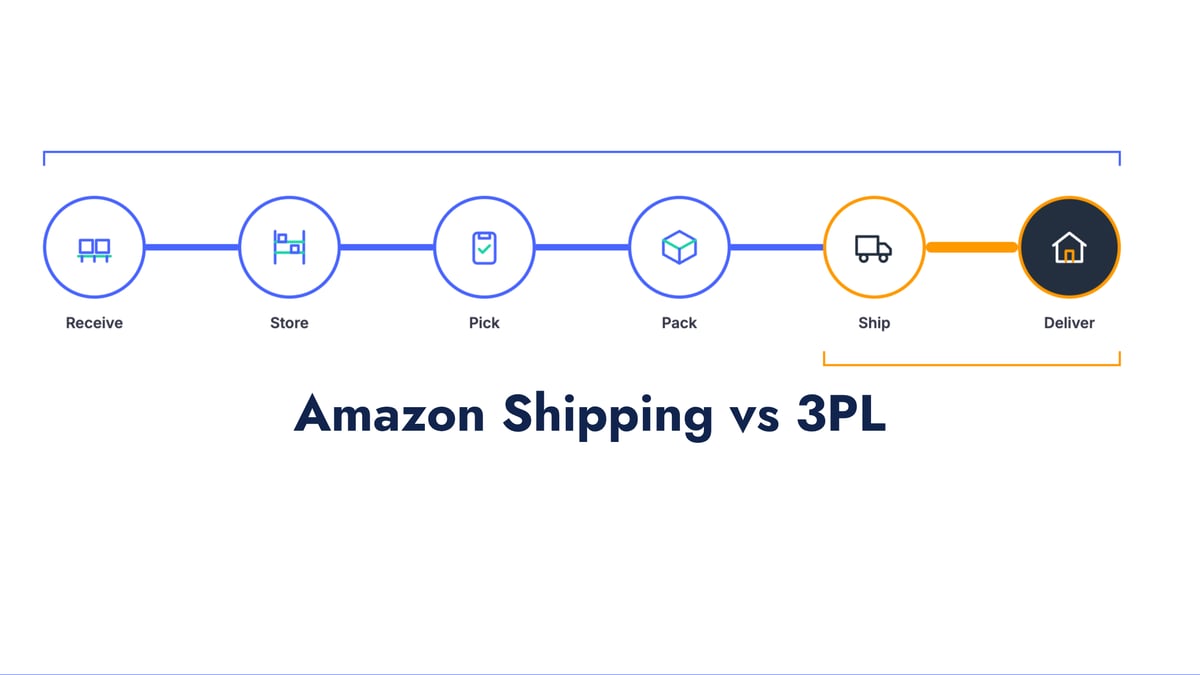
Amazon maintains a series of fulfillment solutions in the form of Amazon Multi-Channel Fulfillment (MCF) and Fulfillment by Amazon (FBA). Your business can use these solutions by paying Amazon a fee to store inventory and manage fulfillment. Amazon Shipping is the in-house parcel delivery fleet that distributes orders picked and packed by MCF and FBA fulfillment centers.
The Amazon branding and similar logistics among each of these solutions can make it somewhat confusing. That’s why we created this guide to define what Amazon Shipping actually is, how it differs from Amazon's other logistics offerings, and how a 3PL offers a more scalable fulfillment model for growing DTC brands.
If you're looking for a robust comparison of a 3PL with Amazon MCF, in particular, you should check out our comparison of Amazon MCF and a 3PL. This article summarizes the differences between Amazon Shipping and Amazon’s other fulfillment solutions, as well as comparing how a 3PL offers more strategic business advantages under the right circumstances.
On this page:
1. What is Amazon Shipping?
2. How Is This Different From Amazon FBA or MCF?
3. What a 3PL Actually Does (That a Carrier Can't)
4. So Which One Do You Actually Need?
5. The Bigger Picture: Amazon Supply Chain Services
6. FAQ
What Is Amazon Shipping?
Amazon Shipping is Amazon’s standalone B2B parcel carrier service. Businesses can buy shipping labels and use Amazon Shipping to deliver off-Amazon orders.
-
Amazon Shipping functions similarly to traditional carriers like UPS or FedEx, though not identical to other distributors.
-
It requires merchants to pick, pack, and label packages before an Amazon driver arrives to collect them for last-mile delivery.
-
You generate a label, hand off a sealed parcel, and Amazon handles the last-mile delivery, typically within two to five business days.
Beginning in May 2026, Amazon Shipping no longer requires sellers to maintain an active Seller Central account on Amazon. Loosened eligibility allows businesses to sign up for a standalone shipper account and use it independent of whether they sell on Amazon's marketplace at all.
While highly competitive on direct pricing, there are several trade-offs.
- Built primarily for Amazon order fulfillment. Firstly, unlike UPS, FedEx, and similar parcel carriers, Amazon Shipping was purpose-built to move Amazon products, lacking the capabilities to handle perishable, temperature-sensitive products.
- Rigid, inflexible fulfillment and distribution options. Secondly, Amazon Shipping has rigid size dimensions, restrictive weight caps, and impersonal customer support.
- Additional fees for non-Amazon channels. Finally, the limited return infrastructure and added fees for non-Amazon marketplace deliveries create additional logistical costs that all but eliminate low upfront pricing.
What is Amazon Shipping’s role in Amazon Supply Chain Services?
Amazon Shipping is one aspect of Amazon Supply Chain Services (ASCS), Amazon’s broader logistics operation that bundles freight, warehousing, fulfillment, and parcel delivery into one platform. ASCS provides end-to-end logistics through Amazon’s global infrastructure, and Amazon Shipping is its in-house parcel delivery carrier.
That's a useful way to think about Amazon Shipping specifically. It's one component of a much larger system, and it doesn’t require you to overhaul how your business handles fulfillment.
With FBA and Amazon MCF, Amazon holds products in a dedicated fulfillment warehouse and handles the picking, packing, and shipping. Amazon Shipping is the parcel carrier service, acting as a distributor that requires your business or your fulfillment partner to handle inventory and pack orders. Alternatively, a 3PL operates as an independent, but strategic partner that provides custom fulfillment solutions for growing DTC brands.
The simplest way to tell these programs apart is to ask one question: who holds the inventory? Here's a more direct comparison of them all.
|
FBA |
MCF |
Amazon Shipping |
ASCS |
|
|---|---|---|---|---|
|
What it is |
Fulfillment for Amazon.com orders only. |
FBA's inventory pool extended to every other sales channel. |
A standalone parcel carrier, comparable to UPS or FedEx. |
Umbrella platform bundling freight, warehousing, fulfillment, and parcel shipping. |
|
How it works |
Seller sends inventory to Amazon. Warehouse picks, packs, and ships orders. |
Amazon holds and fulfills inventory from Shopify, Walmart, TikTok Shop, and other orders from one pool. |
Seller or 3PL holds and packs inventory; Amazon only delivers the finished parcel. |
One console spanning FBA, MCF, Amazon Shipping, and freight, open to any business. |
|
Role in inventory management |
Inventory held and managed exclusively for Amazon orders. |
Amazon holds inventory once; every connected channel draws from it. |
No role in inventory storage or management. Only delivery. |
Unified visibility into inventory as it moves through FBA, MCF, AWD, and Amazon Shipping without holding it. |
|
How it relates to a 3PL |
A narrower, Amazon-only alternative, since it can't fulfill orders placed on other channels. |
Offers similar multichannel reach to a 3PL. Enforces controlled pricing, packaging, and delivery choices. |
A 3PL can be reserved for storage, picking, and packing. But it’s more cost-effective and efficient to use the end-to-end capabilities. |
Not a true substitute. It bundles Amazon-owned services, but without a 3PL's negotiated rates or dedicated account relationship. |
Amazon Shipping is not meant to be interchangeable with FBA or Amazon MCF, and it’s also notably different from a 3PL. As described by The Wall Street Journal, Amazon Shipping is a volume-driven parcel carrier built upon a regionalized distribution network. A 3PL, on the other hand, offers more diversified fulfillment experiences that support multichannel DTC networks that are built to scale alongside growing brands.
What a 3PL Actually Does (That a Carrier Can't)
A delivery carrier like Amazon Shipping, UPS, or FedEx solves exactly one problem: getting a pre-picked and packed order to a customer. A 3PL solves everything upstream of that, providing more strategic support for the complete ecommerce fulfillment experience.
A strategic 3PL offers ecommerce fulfillment, along with B2B and retail fulfillment and freight solutions. A good 3PL includes everything from inventory management, picking and packing orders and shipping them out to the customer, taking care of everything from the moment a customer places an order, all the way to being delivered at their doorstep. Most 3PL’s use warehouse management software (WMS) technology to oversee real-time inventory visibility, monitor live order controls, and provide complete fulfillment transparency across every channel you sell,all within one single platform.
The advantages of a 3PL geared for growth include:
-
Predictable, contract-based pricing. Costs are locked into a negotiated agreement instead of shifting every time Amazon updates its fee schedule, making it easier to forecast margins as volume grows.
-
Custom branded packaging. Sellers control the entire unboxing experience, incorporating custom box designs and inserts instead of a carrier's standard packaging.
-
A dedicated Account Manager. Sellers get a direct relationship with someone who knows their account, rather than routing issues through a general support queue.
-
Returns built around your products. Returns programs are tailored to a seller's specific product catalog, not a one-size-fits-all process designed for unrelated products.
-
Carrier flexibility without the legwork. A 3PL can select from multiple carriers, including Amazon Shipping, based on cost, speed, and destination. You don’t have to negotiate and manage those relationships because your 3PL partner rate-shops the best deal on your behalf.
-
A strategically placed warehouse network. Facilities are strategically positioned to cut shipping zones and transit times, not just maximize total footprint.
As a seller, your focus should be on optimizing the buyer experience, running effective marketing campaigns, and maximizing sales. A 3PL is a partner that takes on the order fulfillment arm of your business so you can dedicate more time to the channels that drive growth.
So Which One Do You Actually Need?
A quick checklist can help you select the best solution for your business needs.
-
How many sales channels are you shipping from today? A single channel is manageable with one carrier relationship. Coordinating Amazon, Shopify, Walmart, and wholesale separately gets complicated fast, and that complexity compounds with every channel you add without the proper fulfillment experiences in place.
-
Who currently handles your fulfillment, including inventory storage and order packing? If you already have a warehouse or team doing this, Amazon Shipping is worth evaluating purely as a carrier alongside UPS and FedEx. If you don't, or your fulfillment setup is straining as you grow, this is really a fulfillment question that could require a 3PL partner like Shipfusion.
-
How much time does your team spend managing carriers, rates, and delivery issues? If comparing rates, chasing tracking exceptions, or fielding delivery complaints is eating real hours every week, a 3PL is purpose-built to take it off your plate entirely.
-
Does your growth plan include adding channels or scaling volume? More channels and more volume mean more complexity to coordinate on your own. A 3PL absorbs scaling complexities as you grow, instead of requiring you to rebuild your carrier setup every time something changes.
-
Does your brand experience depend on packaging or a tailored returns process? A carrier never touches your inventory or packaging. If unboxing and returns matter to how customers experience your brand, that need can only be met by a full-service 3PL.
Conclusion
Amazon Shipping, FBA, MCF, and ASCS aren't four versions of the same choice. They're different layers of Amazon's logistics stack, and only some of them directly touch your inventory.
A 3PL doesn't compete with Amazon Shipping, directly, because it’s more than just a shipping solution. 3PLs handle storage, picking, packing, and returns while working with numerous carriers — Amazon Shipping is merely one option among several. If you're ready to see how that works for your business, speak with a fulfillment expert to build a plan that works for you.

FAQs

.png?width=800&height=500&name=Blog%20Banners%20(7).png)
.png?width=800&height=500&name=Blog%20Banners%20(5).png)
-1.png?width=800&height=500&name=Blog%20Banners%20(1)-1.png)