
-1.png?width=1200&height=675&name=Blog%20Banners%20(1)-1.png)
If you route many orders through Amazon, you've probably noticed your Amazon Multi-Channel Fulfillment (MCF) bill creeping upward this year. You're not imagining it, and you're not alone. DTC businesses are asking poignant questions about whether Amazon MCF is still worth it, or if it’s time to rely on a distributor apart from Amazon.
The honest answer is that it depends on how much of your business actually happens off Amazon, and whether that share is growing. This article walks through what changed with Amazon MCF pricing in 2026, what a 3PL offers instead, why Amazon's timing matters more than it might seem, and how to figure out which path fits your brand.
On this page:
- What is Amazon MCF?
- What is Amazon Supply Chain Services (ASCS)?
- What Changed With Amazon MCF Fees in 2026
- How a 3PL Is Different
- The Bigger Picture: Is Amazon MCF Really Worth Its Cost?
- When MCF Still Makes Sense
- When it's Time to Look at a 3PL
- A Quick Framework for Deciding
- FAQ
What Is Amazon MCF?
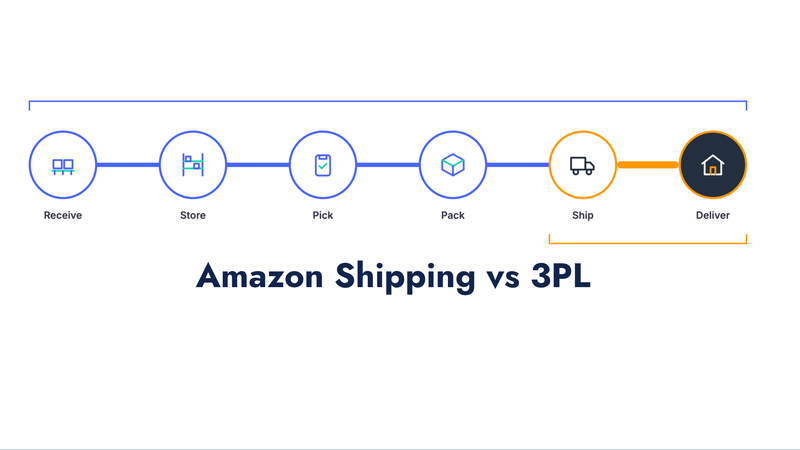
Amazon MCF lets sellers use the inventory they already store in Amazon's fulfillment network to fulfill orders placed anywhere else. You send products into Amazon's warehouses once, and Amazon picks, packs, and ships it whenever that order comes in. It doesn’t matter if that order originated on Amazon, your Shopify store, Walmart, TikTok Shop, or another marketplace.
MCF is a subset of the broader Fulfillment by Amazon (FBA) program, but with an important distinction. FBA fulfills orders placed only on Amazon.com. MCF extends that same inventory pool to fulfill orders across every channel you do business. On the surface, anyway, the appeal here is to have one warehouse relationship, one inventory pool, and orders from every channel flowing through a single system.
That system extends past the warehouse and into delivery, too. Amazon MCF orders ship through a mix of Amazon Logistics, Amazon's own last-mile delivery fleet, and established third-party carriers. The upside here is that orders move fast with reliable delivery, and you can also add fast-shipping badges to your product pages, which can meaningfully lift conversion.
The tradeoff shows up on channels like Walmart, which bars Amazon-branded delivery vehicles in favor of its own neutral packaging rules. Amazon MCF sellers fulfilling Walmart orders have to block Amazon Logistics and ship in unbranded packaging. Blocking Amazon Logistics normally carries a 5% surcharge, though Amazon has temporarily waived that fee through January 2027. It's a useful reminder that MCF's one-size-fits-all delivery setup doesn't fit every channel equally, and the workarounds aren't always permanent.
What is Amazon Supply Chain Services (ASCS)?
Amazon Supply Chain Services, or ASCS, is Amazon's broader logistics umbrella. Announced on May 4, 2026, ASCS provides freight transportation, storage and distribution, fulfillment, and last-mile parcel delivery for Amazon and non-Amazon marketplace sellers alike.
Amazon MCF is specifically the fulfillment and delivery arm of that umbrella, responsible for picking, packing, and shipping orders placed on your other sales channels using Amazon's warehouses and carrier network. Any changes to Amazon MCF fees or delivery setup mean those changes impact the broader ASCS logistics structure of Amazon.
The question this article answers is whether the surface-level benefits of Amazon MCF and ASCS outweigh the added costs of using it.
What Changed With Amazon MCF Fees in 2026
Amazon MCF fees increased beginning January 15, 2026, but the increases weren't distributed evenly. Standard FBA fees rose by an average of $0.08 per unit, while MCF fees rose nearly four times by an average of $0.30 per unit, according to reporting from Supply Chain Dive. Buy with Prime fulfillment fees climbed by $0.24 per unit on average over the same period.
Then, starting May 2, 2026, Amazon layered on a 3.5% fuel and logistics surcharge applied to all MCF fees. Layered on top of the January increase, this means you’re absorbing two separate fee hikes that compound within the same calendar year.
Amazon did soften the blow, somewhat, with a program called MCF Preferred Pricing. This program offers eligible sellers up to 15% off outbound fees, along with FBA credits of up to $1 per unit. The catch is that the top discount tier requires shipping over 19,000 units every 12 weeks, close to 1,600 units a week. Even for sellers who qualify, that’s a hard threshold to reach, and the discount caps out at 100,000 units or 12 months. After that, costs revert to standard rates.
Amazon MCF vs. 3PL: How a 3PL Is Different
A third-party logistics (3PL) partner operates independent of Amazon's pricing decisions. When you work with a 3PL, you negotiate a fulfillment cost contract directly. Most importantly, you’re not subject to a fee schedule that Amazon can revise multiple times per year.
Beyond price stability, a 3PL typically offers several business benefits that MCF simply can't deliver. Suppose you have a very distinct brand with a colorful personality that begins with your packaging. Amazon’s standard pack-out process strips away your individual branding, but a strategic 3PL partner ensures your custom, branded packaging is reflected in every order.
Why is this important? It gives you the ability to control the unboxing experience and bake it into the complete order fulfillment process for every customer. Beginning with the box itself, you control how it’s wrapped, as well as the inserts and tissue paper inside. It might seem like a small detail, but it matters a great deal to DTC businesses with a recognizable brand identity.
Unlike MCF, a 3PL like Shipfusion is built for growing DTC businesses. You get a direct line to a dedicated account manager and proactive account management, rather than being relegated to a support ticket queue. When something goes wrong with an order, you're talking to a person who knows your account instead of routing a case through a general help center.
Any fulfillment issues are managed by your 3PL’s operations team rather than a support ticket queue. If something goes wrong with an order, you're talking to a person who knows your account, not routing a case through a general help center.
Since a 3PL manages your inventory across every sales channel from a system you control, you're not dependent on Amazon's infrastructure to serve your Shopify, Walmart, or wholesale orders. A 3PL manages Amazon orders directly, including FBA prep to keep inventory compliant and Fulfilled by Merchant (FBM) orders that ship straight from the 3PL's own facility. Moving off MCF doesn't mean stepping away from Amazon altogether.
Here's a side-by-side look at how Amazon MCF and a 3PL compares:
|
Factor |
Amazon MCF |
3PL Partner |
|---|---|---|
|
Pricing |
Set by Amazon, subject to fee changes without much notice |
Negotiated contract, stable and predictable |
|
Packaging |
Standard Amazon pack-out |
Fully custom, branded unboxing |
|
Inventory control |
Single Amazon-managed pool |
Managed directly by your team or partner |
|
Multi-channel fulfillment |
Yes, through Amazon's system |
Yes, through a system you control |
|
Customer support |
Portal and support tickets |
Direct relationship with an operations team |
|
International shipping |
Limited, with added surcharges |
Varies by provider, often more flexible |
|
Carrier Mix |
Primarily Amazon-selected partner carriers. Limited seller choice |
Multiple carrier relationships, chosen strategically by shipment, cost, and region |
|
Warehouse network |
200+ Amazon-owned fulfillment centers across 27 countries |
Small number of strategically placed, owned-and-operated hubs, cutting shipping zones and transit times |
|
Best Fit |
Low off-Amazon volume, testing a new channel |
Growing off-Amazon revenue, branding matters |
The Bigger Picture: Is Amazon MCF Really Worth Its Cost?
Remember that Amazon MCF is one aspect of the broader ASCS logistics operation. Amazon is building ASCS into a logistics backbone for businesses of every size, but most DTC brands use Amazon MCF more than anything else.
As Amazon aspires to become the logistics backbone for every kind of business, it’s deliberately increasing fees on the aspect of ASCS logistics that most directly impact sellers’ profit margins.
How the industry is responding
Industry reaction to the ASCS launch has been mixed. Some analysts see real appeal in it, including retail analyst Howard Lake, who told Forbes he expects many brands to be “highly tempted” by ASCS. GlobalData's Neil Saunders is more cautious, quoted in that same Forbes article stating that the move is “distinctly unhelpful for others in the space.” He also noted Amazon “won't immediately dislodge everyone else” given that many logistics and order fulfillment relationships are deeply embedded and costly to dismantle.
There’s another caution against going all-in with Amazon ASCS, which ties to the adage of ‘don’t put all your eggs in one basket.’ DTC brands learned an important lesson during the COVID-19 pandemic and the subsequent supply chain challenges about becoming too beholden to one singular partner.
Matthew Hertz is founder and CEO of Third Person, a platform that connects e-commerce brands with fulfillment partners. Following the announcement of Amazon ASCS, Hertz gave a telling interview describing what brands have learned about the costs of vendor concentration.
“I think COVID-19 and some of these tough times that we've experienced over the last few years have really taught us to create some redundancy in our supply chain and not have all our eggs, figuratively speaking, under one roof.”
Hertz also reiterated that the market itself resists consolidation, pointing out that more than 10,000 3PLs operate in the United States alone. Unlike cloud computing, physical logistics isn't a winner-take-all business.
What the data says
The numbers back up that shift in thinking. According to a 2025 study cited by Retail Brew, about 87% of businesses now offload their shipping and logistics to a third-party provider, up 25% from 2024.
Separately, Gartner research has found that 89% of companies experienced a supplier risk event within the past five years, and most lacked a clear framework to respond quickly. These examples emphasize that diversifying fulfillment across multiple trusted partners is a standard, strategic practice so brands avoid repeat supply chain disruptions.
To be clear, none of this means Amazon's logistics network is a bad option. Depending on the size and scope of your business, it can function as the optimal fulfillment platform to help you manage end-to-end customer experiences.
It simply means that brands with meaningful business outside Amazon should err on the side of caution before routing fulfillment of those orders through a provider with real, measurable levels of risk. You also can’t be too sure when fee increases will be arbitrarily enforced.
When MCF Still Makes Sense
If you’ve determined that Amazon MCF is the right fit for your business, make sure you have a compelling business case to justify your decision. Here are a few scenarios where it makes the most sense.
Most DTC brands aspire to build multichannel sales engines, but there will always be channels driving the most purchase orders. Should that be the case where off-Amazon order volume is genuinely low relative to your Amazon sales, the convenience of one connected system outweighs the fee premium. The absolute dollar impact is manageable if the unit count is small.
It's also a reasonable decision while testing new sales channels. If you're in the early days of testing sell-through on TikTok Shop or Walmart, and you’re unsure either will grow into a meaningful driver of new business, routing and managing early orders with Amazon MCF tracking eliminates more fulfillment logistics before you've validated demand.
Similarly, your brand may not prioritize custom packaging and unique unboxing experiences. In those cases, Amazon’s standard pick, pack, and shipping process makes both fiscal and logical sense. Keep the packaging costs low if customization isn’t required.
When it's Time to Look at a 3PL
The calculation shifts once your off-Amazon volume becomes a real part of the business rather than a side channel. At that point, the widening gap between FBA and Amazon MCF pricing compounds into an expensive undertaking. By negotiating a standard 3PL rate, it’s a fixed cost rather than a variable fee that can adjust every time Amazon changes fee schedules. By placing a premium on consistency, a 3PL makes fulfillment pricing models make sense.
Branding is the other major trigger. If you're building a DTC presence where the unboxing experience matters to your customer relationship, Amazon’s standardized pack-out becomes a real limitation rather than a minor inconvenience.
Returns are worth factoring in too. According to the National Retail Federation's 2025 Retail Returns Landscape report, the ecommerce return rate sits at roughly 19.3%, nearly one in five online orders. Amazon provides a standardized returns process, but many brands need more flexibility than their typical system.
Returns require inspection, restocking, or repackaging tailored to specific product needs, particularly sensitive products with temperature, lighting, and other environmental concerns. A 3PL builds a returns processing workflow tailored to your business requirements, rather than enforcing a one-size-fits-all returns system.
Amazon MCF promises speedy deliveries, but that promise doesn’t carry the same weight it once did. Research from McKinsey on ecommerce delivery preferences found that delivery speed, which was a top consumer priority in 2022, fell to fifth by 2024.
Today, 90% of customers are willing to wait two to three days for an order. Current consumer satisfaction rates are largely driven by order reliability and predictability, not just raw speed, reducing the value of Amazon’s fulfillment speed as a business KPI.
A Quick Framework for Deciding
If you're still weighing the decision, these four questions can help clarify where you land.
-
How much of your revenue actually comes from channels outside Amazon, and is that share growing? A small, stable slice can still work on Amazon MCF. A thriving multichannel brand shifts the math in favor of a trusted 3PL with each passing quarter.
-
Have you actually calculated what the 2026 fee increases are costing you specifically? Many sellers feel the pinch without knowing it. Pull MCF reports from before and after January 15 to see the exact delta on your top-selling product SKUs.
-
Does your brand experience depend on packaging? If unboxing and presentation are part of your brand experience, that's a structural limitation Amazon MCF can't solve. A trusted 3PL partner like Shipfusion excels at custom packouts.
-
Finally, do you want your fulfillment costs to move every time Amazon updates its fee schedule? If you’re the type of owner, operator, or executive who values control over operating expenses, then a trusted 3PL partner is the more strategic business decision.
Conclusion
Amazon's 2026 fee changes didn't break Amazon MCF, and to reiterate, it still has a place for brands with low off-Amazon order volume. What those fee increases and the launch of ASCS did was trigger deeper conversations about fulfillment’s role in DTC businesses.
With a 3PL, order fulfillment becomes a proactive business practice, not a passive, default setting. If you're ready to see what a dedicated fulfillment partner could look like for your business, speak with a fulfillment expert to walk through the numbers together.

FAQs

-2.png?width=800&height=500&name=Blog%20Banners%20(1)-2.png)
.png?width=800&height=500&name=Blog%20Banners%20(7).png)